
'Chinese troops are not geared to fight Indian troops who are battle hardened and acclimatised and are far more hardy.'

'The Kashmir issue has become internationalised after nearly half a century.' 'India, not Pakistan, has done so pro-actively,' says Shekhar Gupta.
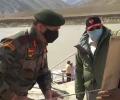
'We should not minimise the seriousness of Chinese encroachments because their perception is different.' 'Nor should we fall into the trap of accepting so-called 'buffer zones' in areas of overlapping claims. We cannot have buffer zones in our own territory,' asserts Ambassador Shyam Saran, a former foreign secretary.

There is a vocal constituency of educated, well-to-do, articulate Indian elites who would rather go with the idea that too much democracy is a liability. That India needs a spell of benevolent dictatorship. Of course, they have never lived under one, points out Shekhar Gupta.
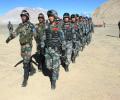
'They have done in Eastern Ladakh what we did in Dokalam in 2017.'
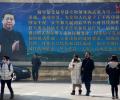
'The boundary dispute notwithstanding, China has always had leaders who have been, on the whole, positively disposed towards India.' 'Given the centrality of the Chinese Communist Party, we need to strengthen the linkages with the crucial personalities in the highest echelons of the Communist party and political leadership,' notes China expert Alka Acharya.
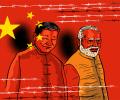
'An opportunity is at hand to think big and recast the India-China relationship on a new template, which would help the pursuit of our country's dream of major power status,' says Ambassador M K Bhadrakumar.

'Is Xi's China stable?'
'No one can say whether the regime will fall all at once or if its leaders are devising a new solid and competitive -- anything but democratic -- model.' A fascinating excerpt from Francois Bougon's Inside The Mind of Xi Jinping.

His challenge now may be coping with Alibaba's undoubted status as a whale in the world of e-commerce.

All the three issues raised by China at the Modi-Xi meeting are either intractable or peripheral to the bilateral relations and suggest conventional methods to placate the other side without yielding much, says Srikanth Kondapalli.

'Building on the potential for closer ties is the changing narrative in each country about the other. The Chinese narrative on India has become significantly more positive over the past few years,' says Walter Andersen and Zhong Zhenming.

In the case of India, there are no specific references in China's white paper. However, there are several takeaways for India, says Srikanth Kondapalli.
The Indian economy can grow if it is delinked from the slow growth in the West and the deceleration in China, says Ashok K Lahiri.

No country has achieved a faster, deeper modern transformation than China, says former ambassador Kishan S Rana.

'China, which had earlier blockaded New Delhi's bid to join the Nuclear Suppliers Group by citing the nuclear non-proliferation law, finds itself in an awkward position and international isolation.' 'India needs to pursue a policy of mediation between China and the Southeast Asian countries for regional security,' says Srikanth Kondapalli.

This is the time when the US would need the conceptual strategic thinking of a Henry Kissinger, able to ally diplomatic skills with a well-conceived worldview of what the emergence of a new balance of forces will mean for a US whose ability to shape global events has definitely declined but still exists, says Claude Smadja.

One has to wonder what is so wrong with the European Union.

'Usually, the Left backed the Congress and other 'secular' parties on the justification of keeping the BJP out. In Bengal, the alliance targets a truly secular rival,' says Shekhar Gupta.

Sadly, for hundreds of millions in India, that inequality from their birth and the utterly inadequate schooling and health care they receive thereafter mean that the lottery is stacked against them.

The Chinese leader will display his grip on the Communist party and chart his plans for his country's future.

How did Greece, the country of Archimedes and Socrates and Plato and Pythagoras, come to such dire straits, asks Ajit Balakrishnan.

The Chinese Communist Party's all important 19th Party Congress is just months away, and President Xi Jinping finds himself confronting unlikely challenges to his pre-eminent position, says former RA&W officer and China watcher Jayadeva Ranade.

'The mood in Beijing is already nervous and feverously watchful.' 'Developments in China will be scrutinised as intensely and nervously as the ones in Washington,' says Claude Smadja.

'The Tibetan movement will never turn violent during the Dalai Lama's life-time.'

'The American fear of the Chinese military is overblown. The countries that should be concerned are China's neighbours,' Jeffrey Wasserstrom tells Rahul Jacob.

China has relaxed its one-child policy and further freed up markets in order to put the world's second-largest economy on a more stable footing.

Despite vast differences in the way the media operates in the two countries, an India-China media forum will go a long way in improving understanding between the two countries, says Srikanth Kondapalli.

'The supreme art of war is to subdue the enemy without fighting.' Former RA&W official Jayadeva Ranade explains what China's military reforms mean for the world.

'There are reports of political dissent mounting on Xi Jinping's handling of the Wuhan fallout.'

The bogey of the 1962 defeat must be laid to rest with a finality that is unquestionable. The myth of Chinese invincibility is a tall tale that belongs to an era gone by, says Vivek Gumaste.

'Tibet remains a prickly issue between the giant Asian nations. China still claims more than 80,000 sq kilometres of Indian territory in the Northeast. Why? Just because Beijing refuses to acknowledge the McMahon line which separates India and Tibet, and this, simply because the 1914 Agreement delineating the border was signed by the then government of independent Tibet with India's then foreign secretary (Sir Henry McMahon),' says Claude Arpi.

'The Communist rule in Tripura was exceptional while it lasted for a quarter century in giving good governance.' 'The chief minister himself was the paragon of virtues in his dedication in public life.' 'But all that still didn't add up when the BJP's dream merchants came up with their famous 'development agenda'.' 'One thing that emerges indisputably in the Tripura election results is that needs and aspirations more or less narrow down to one little word -- jobs,' says M K Bhadrakumar.

'The military aim in a future conflict, if it can't be avoided, should be to cause maximum damage to the adversary's war waging capability and capture limited amount of territory as a bargaining counter,' says Brigadier Gurmeet Kanwal (retd).

'After more than 20 years of understanding, nothing much seems to have been achieved. What the two countries have been trying to do is to manage the recurrence of border incursions. The two sides must address the disease, and not the symptom of the disease,' says Rup Narayan Das.

'To consider BRICS anything more than a temporary club with some common interests would be folly. The goal should be to induce others (Japan, ASEAN, South Africa) to align with us -- a non-threatening, democratic nation, rather than with malevolent China or waning America. For us to consider aligning with either China or the US would be absurd. India is just too big to be a sidekick,' says Rajeev Srinivasan.

In the second and final part of his column, Col Anil Athale says the fight between forces of Indian nationalism and Macaulayism aided and abetted by West is going to be long, hard and dirty. The outcome will decide whether India becomes a superpower or continues to wallow in the swamp of underdevelopment.

2014 was a year for downturn for most economies across the globe.

There are signs of China's external behaviour becoming more aggressive in the coming years. If that happens, strategic implications for neighbours having territorial disputes with China can become deeper and imperatives can rise for the former to counteract, says D S Rajan

If the chemistry between Modi and Xi Jinping goes well, it will herald a new future not just for the region but for the world, says Tarun Vijay.

'India is a huge market for Chinese goods. I don't think a war stands to logic when you have economic compulsions, but then Chinese are known to do illogical things.'
